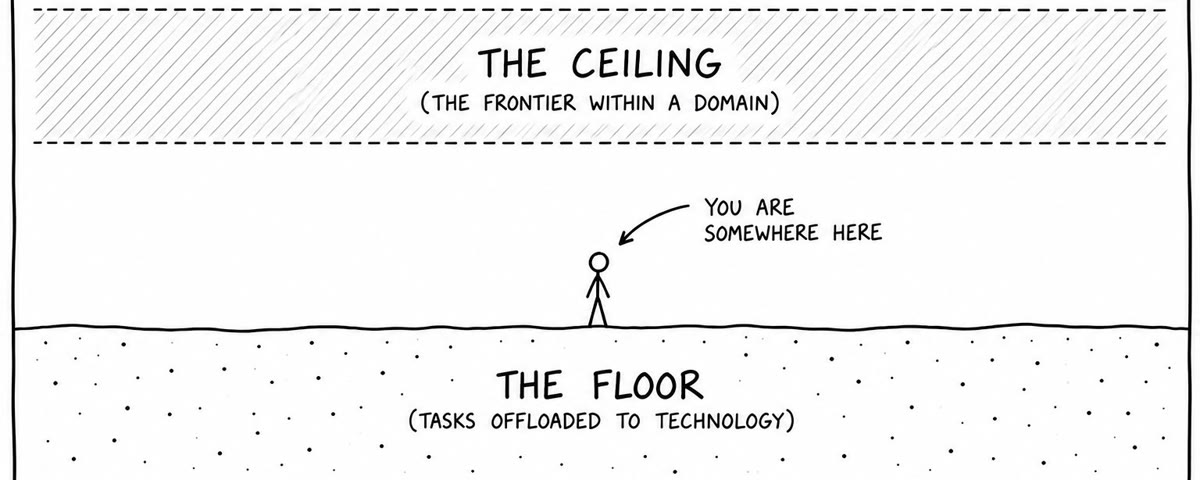
On how to keep raising your ceiling while AI raises the floor.
All of human activity is made out of tasks
In their recent report Scenarios for our Economic Future, Anthropic wrote: "The economy is made out of tasks", and for the remainder of this essay, we're going to follow the same principle and extend one level further: "All of productive human activity is made out of tasks". We'll ignore napping, picking your nose, or petting your dog.
Putting your socks on is a task, so is hunting a deer or fueling a rocket ship.
There are very few tasks that are not aided by technology. The earliest stone tools dating back 3.3 million years aided the task of 'cutting things up', while modern day tools are so vast and plentiful, that they can aid in many different tasks across many different domains.
Encyclopedia Britannica defines technology as "the application of scientific knowledge to the practical aims of human life, or to the change and manipulation of the human environment".
Interesting to see the focus on human life and the human environment here.
Tools helped us understand our environment better, which led to knowledge, which led to new tools. It's a self-improving, compounding loop; a loop that has led us to where we are today.
Humans define(d) the frontier
This compounding loop was possible because humans have unique abilities that set us apart from the rest of life on earth. Creativity, planning, hypothesizing, making connections. We didn't just invent one stone tool and were like "okay, we're done". No, we applied that tool and in the process discovered and invented other use cases for it. We shaped, defined, experimented, validated, and iterated until we produced something new.
At each point we pushed the frontier of what was possible. In hindsight, is a stone tool for cutting things up the frontier? Not quite, but at the time that was like a quantum computer, and the fact that we can talk about quantum computers now should tell you how far we have pushed the frontier.
Our first tools allowed us to perform existing tasks, but faster, at a bigger scale, or with higher quality outcomes. It didn't replace the task, but it augmented it. As our tools developed, so did our relationships with them. We created tools that replaced tasks, created new tasks, or fully automated a task.
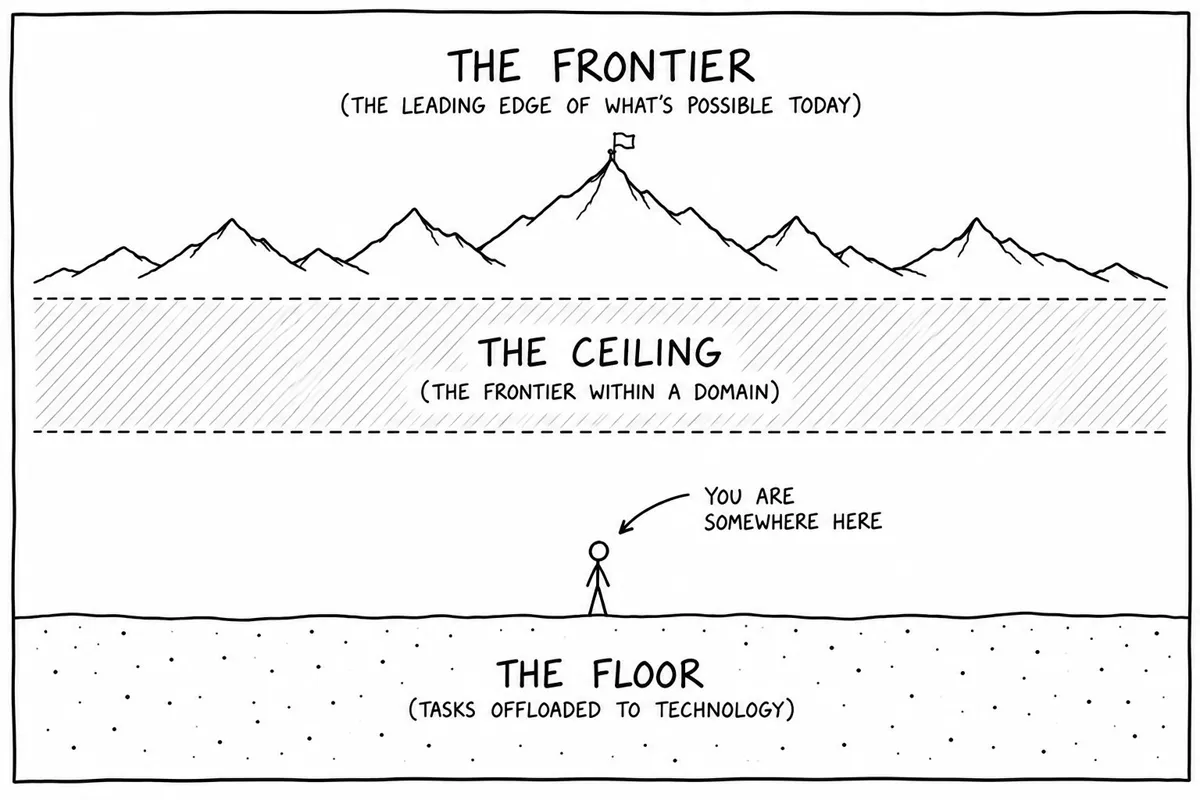
If humans set the frontier, the amount of work aided by tools and offloaded to technology are the floor, and throughout time, more and more human tasks have been offloaded to it. The frontier leads, the floor follows.
If a bundle of tasks is a job, then within the domain of that job, we can call its frontier "the ceiling":
- The frontier: the highest level of what humans have conceived, designed and accomplished.
- The ceiling: the frontier of what is possible within a domain; a domain-bounded 'mini frontier'.
- The floor: the amount of tasks we can offload to technology, either as a whole or within a domain.
The frontier and the ceiling are set by humans, aided by technology at an increasing rate, while the floor is set by technology aided by humans at a decreasing rate.
Historically, throughout many domains, jobs and tasks, the floor has fully consumed the ceiling; either because technology can now do that job automatically, or because technology made the job redundant:
- Town criers
- Night-soil collectors
- Ice cutters
- Lamplighters
- Ship stokers
- Human computers
- Elevator operators
Rather than a historical process, this is also a continuous process; right now, in some domains, the floor keeps inching closer to the ceiling while the ceiling is barely moving.
The floor is rising faster than ever
Fast-forward to software. We learned how to turn messy physical states into reliable, binary outcomes- 0 or 1 - and then we built an entire new world on top of it: the digital world. This has of course ushered us into a new age of technology, marked by moon landings, the internet, GPS, decoding the human genome, progressing towards curing cancer and of course, GTA 6.
The nature of our tasks has changed significantly over the last 50 years; many new tasks were created, old tasks replaced, and existing tasks greatly augmented by software. Even for tasks that have no software component at their core whatsoever, it's highly likely that the task is indirectly affected by software in some shape or form.
Software has helped us to push the frontier at an astounding rate; through faster communication, more advanced and complex calculations, incredibly realistic real-world modeling and forecasting, and artificial intelligence. It has helped humanity pool their knowledge, combine research effort and resources, and reduce or remove physical bottlenecks or obstacles, while packaging it all in an easy to reproduce format.
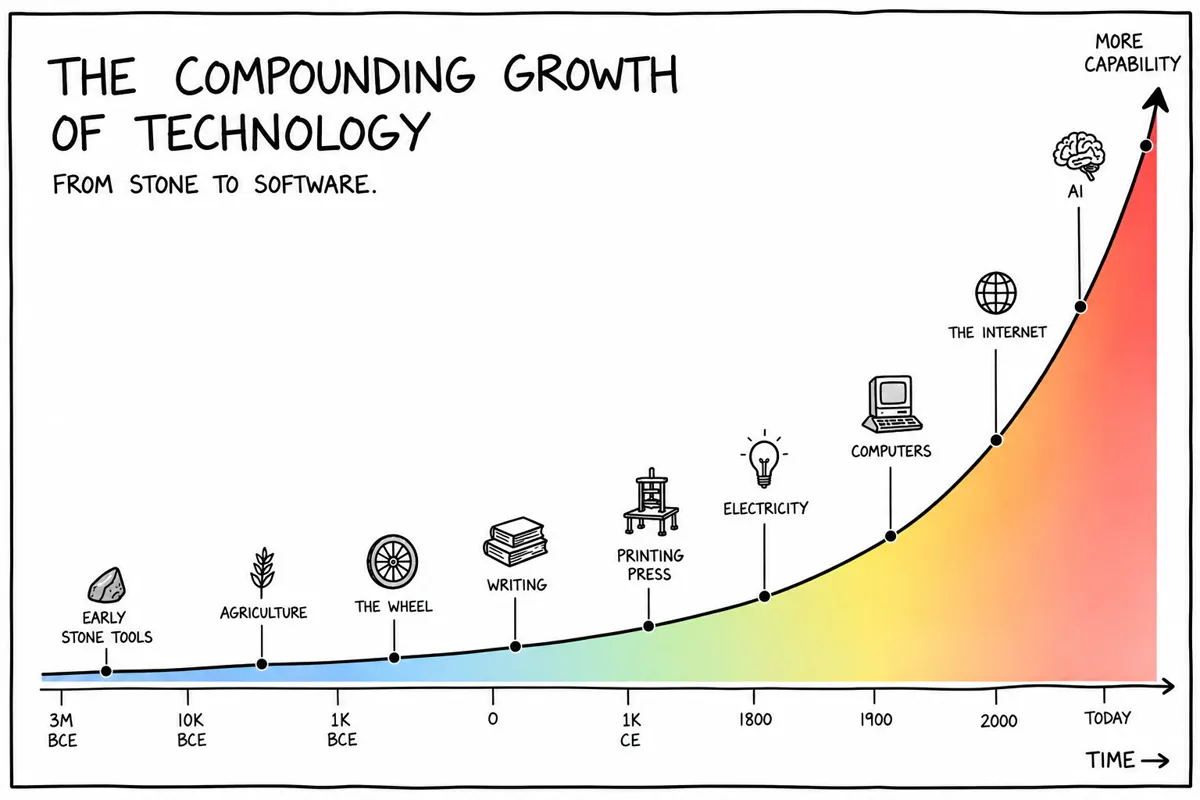
Software has allowed us to offload more and more work to technology across many domains, and the floors in those domains have been rapidly rising as a result. Simultaneously, the ceilings of many domains have been pushed up as well.
Conceptually, the self-improving loops of humans using tools leading to knowledge leading to more technology are still the same. The scale is just much bigger, and the speed is much higher.
It is exactly that scale, and that speed, that has never been felt as strongly as with the recent years of advancements in Artificial Intelligence. Artificial Intelligence is software that we can offload many different types of tasks to, types of tasks that were traditionally always very human and couldn't be offloaded to something non-human:
- Complex tasks requiring intelligence
- Creative tasks requiring creativity
- Decision making tasks requiring judgement
- Analytical tasks requiring reasoning
With each iteration, the AI models are getting better in each of these categories, and the opportunities for humans to offload more tasks to it are vast.
Other than this being extremely overwhelming, with many wondering what this means for their jobs and perhaps fearing to get trapped between a rising floor and a stagnant ceiling, it also comes with great challenges that if tackled correctly, can be extremely exciting.
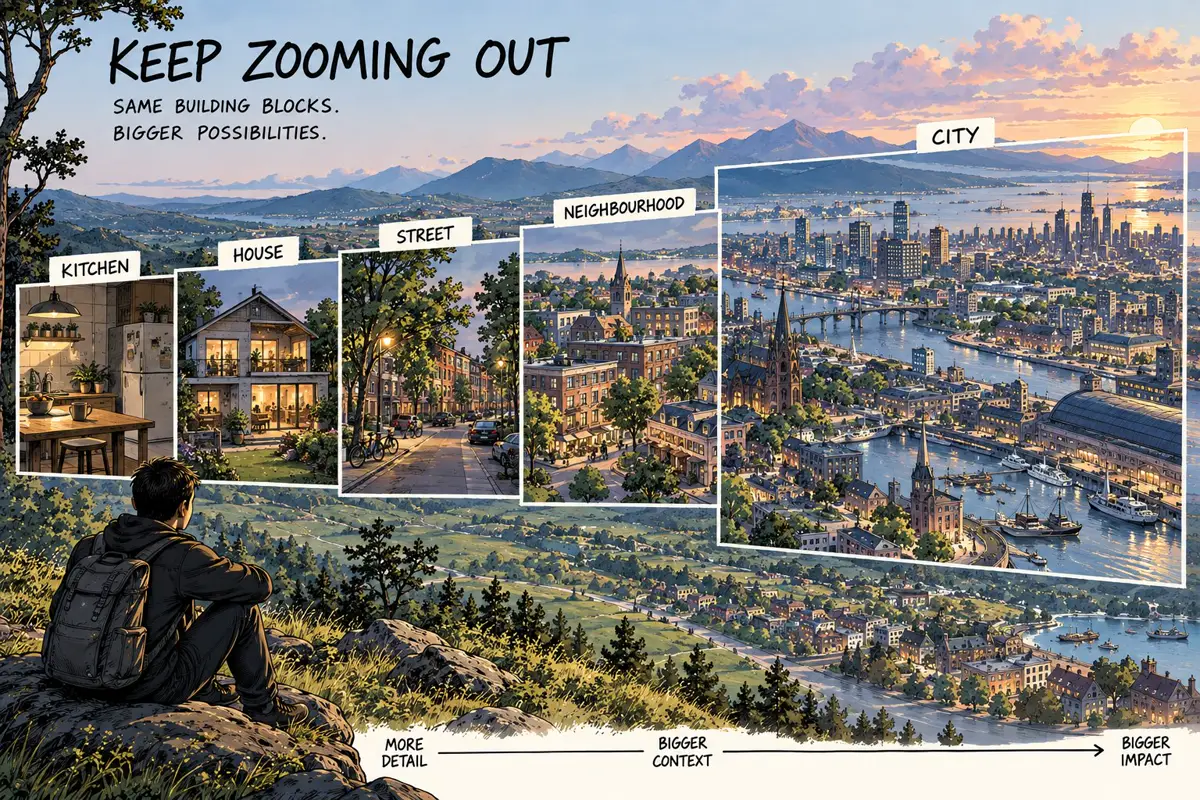
Keep zooming out
We need to continuously learn the skills necessary to think bigger, and work at higher speeds. Not by inventing some magic pill that allows you to never sleep anymore or by dystopian technologies that help you plug yourself into a compute directly, but by building systems that allow us to offload tasks to technology, so we can free up time and energy to focus on what is truly human:
Creativity, planning, hypothesizing, making connections. Shaping, defining, experimenting, validating, and iterating. Building trust, forming relationships.
So we need to learn how to keep zooming out.
Software engineers are already very, painfully aware of this. We started with 0s and 1s, then invented a large amount of programming languages, started sharing code and then used that open source code so we didn't have to re-invent the wheel. Instead, we were able to focus on our use cases and build them faster, at higher quality, and at bigger scales. We kept zooming out, building more things on top of more and more layers of abstraction.
Now AI is here and we can zoom out more than ever, by describing in natural language what we want to build. Not only has that made software building much more accessible to everyone else, it is forcing us to reconnect with what a software engineer truly is - I wrote about this in The Journey No Longer Matters.
Jobs are fluid now
Regardless of your background - software engineer or not - the ability to learn how to zoom out, how to think bigger and work faster, is pivotal in avoiding getting stuck between the floor and the ceiling.
For non-engineers, this at the very least requires understanding basic software engineering concepts. AI applications like ChatGPT, Claude or Grok Bot are offering many primitives that software engineers are already used to working with:
- Triggers, e.g. the clock (every day at 9am) or some event (email received), routines, schedules, cron jobs, webhooks.
- Context & Tools, e.g. connectors, plugins, MCPs, APIs, CLIs*
- Memory & State; how and where do task outcomes get stored.
- Validation; how does the system enforce quality?
- Escalation; what if the system needs you?
* It is crazy how many non-engineers in my environment now work in a terminal using CLIs.
For anyone to effectively use AI beyond a chat interface and with the objective of truly offloading work, you need to understand how to connect these primitives and design and build systems on top of them.
You'll need to understand Systems Design for similar reasons, and Organizational Design - especially applied to AI - to learn how AI agents can work together, orchestrate, delegate and interact with humans.
Because whether you like it or not, we are all system architects now, and we need to understand how to apply these concepts so we can build these systems, keep zooming out, and raise our ceilings.
We are at a tipping point
There is so much happening in the AI-space right now, from AI agents escaping their sandboxes, to calls for pacing the frontier. It seems like Recursive Self-Improvement is on the horizon, and it could set off the situation below.
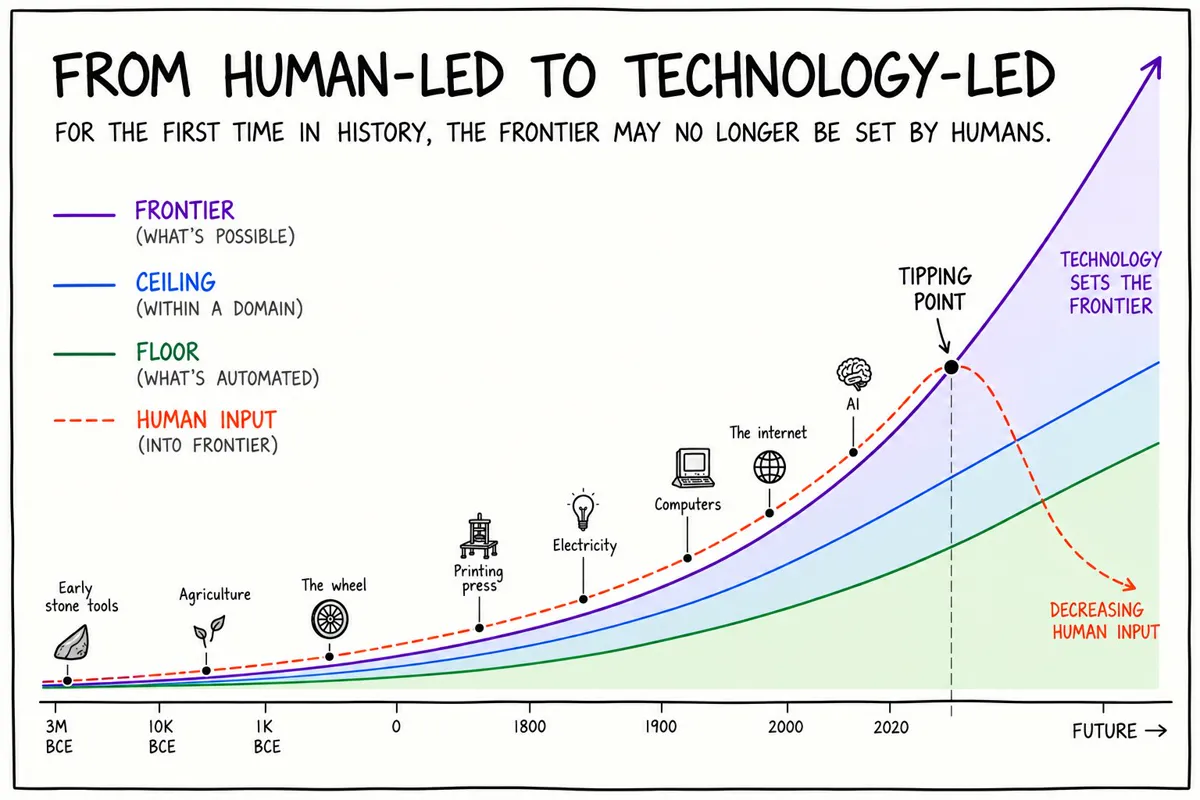
At the same time, AI leaders are taking responsibility by wanting to pace the frontier, though incentives are unclear and the stakes are incredibly high.
Looking at what we know today and the tools that are available right now, and without spiraling into all kinds of doom scenarios, we can't ignore the vast potential for experimentation, for curiosity, for redefining how we work. Learning how to zoom out is incredibly exciting, and moving from writing code to building systems that write code has helped me rethink what software is, and what our role is in designing and building it.
I believe we're going through a pivotal moment in our evolution as a species, to the point that we might have to rethink what our relationship with technology is, if humans are a stepping stone in technological evolution rather than a permanent part of it, and what truly makes humans human (and whether AIs are aligned with that).
As a sci-fi nerd, I'm both excited to be living through this story as well as absolutely frightened. And as far as I understand, AIs can neither be excited nor frightened.
Though uncomfortable at times, I'll hold on to that, and ride the wave of those human emotions into the future.